

The Stooge sort is a recursive sorting algorithm. It is defined as below (for ascending order sorting).
Step 1 : If value at index 0 is greater than value at last index,
         swap them.
Step 2: Recursively,
        a) Stooge sort the initial 2/3rd of the array.
        b) Stooge sort the last 2/3rd of the array.
        c) Stooge sort the initial 2/3rd again to confirm.
NOTE: Always take the ceil of ((2/3)*N) for selecting elements.
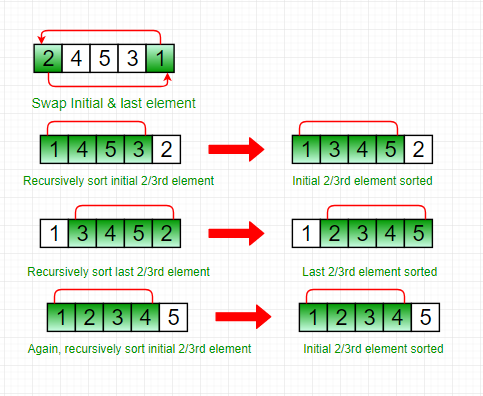
Illustration
Input :   2 4 5 3 1
Output : 1 2 3 4 5
Explanation:
Initially, swap 2 and 1 following above step 1.
          1 4 5 3 2
          Now, recursively sort initial 2/3rd of the elements.
          1 4 5 3 2
          1 3 4 5 2
          Then, recursively sort last 2/3rd of the elements.
          1 3 4 5 2
          1 2 3 4 5
          Again, sort the initial 2/3rd of the elements to
          confirm final data is sorted.
          1 2 3 4 5
CODE
# Python program to implement stooge sort

def stoogesort(arr, l, h):
    if l >= h:
        return

    # If first element is smaller
    # than last, swap them
    if arr[l]>arr[h]:
        t = arr[l]
        arr[l] = arr[h]
        arr[h] = t

    # If there are more than 2 elements in
    # the array
    if h-l + 1 > 2:
        t = (int)((h-l + 1)/3)

        # Recursively sort first 2 / 3 elements
        stoogesort(arr, l, (h-t))

        # Recursively sort last 2 / 3 elements
        stoogesort(arr, l + t, (h))

        # Recursively sort first 2 / 3 elements
        # again to confirm
        stoogesort(arr, l, (h-t))


# driver
arr = [2, 4, 5, 3, 1]
n = len(arr)

stoogesort(arr, 0, n-1)

for i in range(0, n):
    print(arr[i], end = ' ')
Output: 1 2 3 4 5
Time complexity
Worst complexity: n^(log3/log1.5)
Average complexity: n^(log3/log1.5)
Best complexity: n^(log3/log1.5)
Space complexity: n
Stable: No
Class: Comparison sort
Worst-case space complexity: O(n)
T(n) = 3T(3n/2) + ?(1)
Solution of above recurrence is O(n(log3/log1.5)) = O(n2.709), hence it is slower than even bubble sort(n^2).
 Python, Data structures, OOPS, Big O