

QuickSort is a Divide and Conquer algorithm. It picks an element as pivot and partitions the given array around the picked pivot. There are many different versions of quickSort that pick pivot in different ways.
- Always pick first element as pivot.
- Always pick last element as pivot (implemented below)
- Pick a random element as pivot.
- Pick median as pivot.
The key process in quickSort is partition(). Target of partitions is, given an array and an element x of array as pivot, put x at its correct position in sorted array and put all smaller elements (smaller than x) before x, and put all greater elements (greater than x) after x. All this should be done in linear time.
Pseudo Code for recursive QuickSort function :
/* low  --> Starting index,  high  --> Ending index */
quickSort(arr[], low, high)
{
    if (low < high)
    {
        /* pi is partitioning index, arr[pi] is now
           at right place */
        pi = partition(arr, low, high);

        quickSort(arr, low, pi - 1);  // Before pi
        quickSort(arr, pi + 1, high); // After pi
    }
}
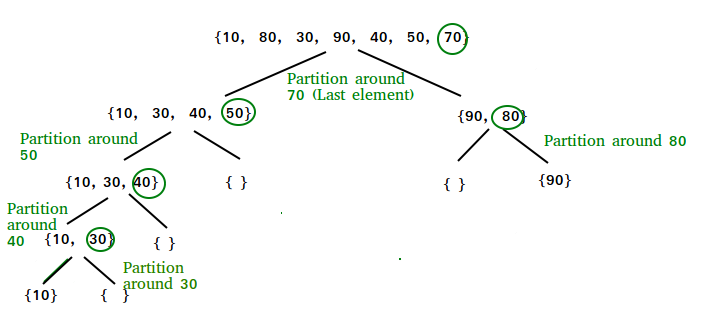
Partition Algorithm
There can be many ways to do partition, following pseudo code adopts the method given in CLRS book. The logic is simple, we start from the leftmost element and keep track of index of smaller (or equal to) elements as i. While traversing, if we find a smaller element, we swap current element with arr[i]. Otherwise we ignore current element.
/* low  --> Starting index,  high  --> Ending index */
quickSort(arr[], low, high)
{
    if (low < high)
    {
        /* pi is partitioning index, arr[pi] is now
           at right place */
        pi = partition(arr, low, high);

        quickSort(arr, low, pi - 1);  // Before pi
        quickSort(arr, pi + 1, high); // After pi
    }
}
Pseudo code for partition()
/* This function takes last element as pivot, places
   the pivot element at its correct position in sorted
    array, and places all smaller (smaller than pivot)
   to left of pivot and all greater elements to right
   of pivot */
partition (arr[], low, high)
{
    // pivot (Element to be placed at right position)
    pivot = arr[high];

    i = (low - 1)  // Index of smaller element

    for (j = low; j <= high- 1; j++)
    {
        // If current element is smaller than the pivot
        if (arr[j] < pivot)
        {
            i++;    // increment index of smaller element
            swap arr[i] and arr[j]
        }
    }
    swap arr[i + 1] and arr[high])
    return (i + 1)
}
Illustration of partition() :
arr[] = {10, 80, 30, 90, 40, 50, 70}
Indexes:  0   1   2   3   4   5   6

low = 0, high =  6, pivot = arr[h] = 70
Initialize index of smaller element, i = -1

Traverse elements from j = low to high-1
j = 0 : Since arr[j] <= pivot, do i++ and swap(arr[i], arr[j])
i = 0
arr[] = {10, 80, 30, 90, 40, 50, 70} // No change as i and j
                                     // are same

j = 1 : Since arr[j] > pivot, do nothing
// No change in i and arr[]

j = 2 : Since arr[j] <= pivot, do i++ and swap(arr[i], arr[j])
i = 1
arr[] = {10, 30, 80, 90, 40, 50, 70} // We swap 80 and 30

j = 3 : Since arr[j] > pivot, do nothing
// No change in i and arr[]

j = 4 : Since arr[j] <= pivot, do i++ and swap(arr[i], arr[j])
i = 2
arr[] = {10, 30, 40, 90, 80, 50, 70} // 80 and 40 Swapped
j = 5 : Since arr[j] <= pivot, do i++ and swap arr[i] with arr[j]
i = 3
arr[] = {10, 30, 40, 50, 80, 90, 70} // 90 and 50 Swapped

We come out of loop because j is now equal to high-1.
Finally we place pivot at correct position by swapping
arr[i+1] and arr[high] (or pivot)
arr[] = {10, 30, 40, 50, 70, 90, 80} // 80 and 70 Swapped

Now 70 is at its correct place. All elements smaller than
70 are before it and all elements greater than 70 are after
it.
CODE
# Python program for implementation of Quicksort Sort

# This function takes last element as pivot, places
# the pivot element at its correct position in sorted
# array, and places all smaller (smaller than pivot)
# to left of pivot and all greater elements to right
# of pivot
def partition(arr,low,high):
    i = ( low-1 )         # index of smaller element
    pivot = arr[high]     # pivot

    for j in range(low , high):

        # If current element is smaller than the pivot
        if   arr[j] < pivot:

            # increment index of smaller element
            i = i+1
            arr[i],arr[j] = arr[j],arr[i]

    arr[i+1],arr[high] = arr[high],arr[i+1]
    return ( i+1 )

# The main function that implements QuickSort
# arr[] --> Array to be sorted,
# low  --> Starting index,
# high  --> Ending index

# Function to do Quick sort
def quickSort(arr,low,high):
    if low < high:

        # pi is partitioning index, arr[p] is now
        # at right place
        pi = partition(arr,low,high)

        # Separately sort elements before
        # partition and after partition
        quickSort(arr, low, pi-1)
        quickSort(arr, pi+1, high)

# Driver code to test above
arr = [10, 7, 8, 9, 1, 5]
n = len(arr)
quickSort(arr,0,n-1)
print ("Sorted array is:")
for i in range(n):
    print ("%d" %arr[i])
Output: Sorted array:
1 5 7 8 9 10
Analysis of QuickSort
Time taken by QuickSort in general can be written as following.
T(n) = T(k) + T(n-k-1) +(n)
The first two terms are for two recursive calls, the last term is for the partition process. k is the number of elements which are smaller than pivot.
The time taken by QuickSort depends upon the input array and partition strategy. Following are three cases.
Worst Case: The worst case occurs when the partition process always picks greatest or smallest element as pivot. If we consider above partition strategy where last element is always picked as pivot, the worst case would occur when the array is already sorted in increasing or decreasing order. Following is recurrence for worst case.
T(n) = T(0) + T(n-1) +
The solution of above recurrence is (n2).
Recursive Quick Sort
# Python program for implementation of Quicksort Sort

# This function takes last element as pivot, places
# the pivot element at its correct position in sorted
# array, and places all smaller (smaller than pivot)
# to left of pivot and all greater elements to right
# of pivot
def partition(arr,low,high):
    i = ( low-1 )         # index of smaller element
    pivot = arr[high]     # pivot

    for j in range(low , high):

        # If current element is smaller than the pivot
        if   arr[j] < pivot:

            # increment index of smaller element
            i = i+1
            arr[i],arr[j] = arr[j],arr[i]

    arr[i+1],arr[high] = arr[high],arr[i+1]
    return ( i+1 )

# The main function that implements QuickSort
# arr[] --> Array to be sorted,
# low  --> Starting index,
# high  --> Ending index

# Function to do Quick sort
def quickSort(arr,low,high):
    if low < high:

        # pi is partitioning index, arr[p] is now
        # at right place
        pi = partition(arr,low,high)

        # Separately sort elements before
        # partition and after partition
        quickSort(arr, low, pi-1)
        quickSort(arr, pi+1, high)

# Driver code to test above
arr = [10, 7, 8, 9, 1, 5]
n = len(arr)
quickSort(arr,0,n-1)
print ("Sorted array is:")
for i in range(n):
    print ("%d" %arr[i])
Output: 2 2 4 6 9
- The above implementation uses last index as pivot. This causes worst-case behavior on already sorted arrays, which is a commonly occurring case. The problem can be solved by choosing either a random index for the pivot, or choosing the middle index of the partition or choosing the median of the first, middle and last element of the partition for the pivot. (See this for details)
- To reduce the recursion depth, recur first for the smaller half of the array, and use a tail call to recurse into the other.
- Insertion sort works better for small subarrays. Insertion sort can be used for invocations on such small arrays (i.e. where the length is less than a threshold t determined experimentally). For example, this library implementation of qsort uses insertion sort below size 7.
Despite above optimizations, the function remains recursive and uses function call stack to store intermediate values of l and h. The function call stack stores other bookkeeping information together with parameters. Also, function calls involve overheads like storing activation record of the caller function and then resuming execution.
The above function can be easily converted to iterative version with the help of an auxiliary stack which is also optimized.
Iterative Quick Sort
# Python program for implementation of Quicksort

# This function is same in both iterative and recursive
def partition(arr, l, h):
    i = ( l - 1 )
    x = arr[h]

    for j in range(l, h):
        if   arr[j] <= x:

            # increment index of smaller element
            i = i + 1
            arr[i], arr[j] = arr[j], arr[i]

    arr[i + 1], arr[h] = arr[h], arr[i + 1]
    return (i + 1)

# Function to do Quick sort
# arr[] --> Array to be sorted,
# l  --> Starting index,
# h  --> Ending index
def quickSortIterative(arr, l, h):

    # Create an auxiliary stack
    size = h - l + 1
    stack = [0] * (size)

    # initialize top of stack
    top = -1

    # push initial values of l and h to stack
    top = top + 1
    stack[top] = l
    top = top + 1
    stack[top] = h

    # Keep popping from stack while is not empty
    while top >= 0:

        # Pop h and l
        h = stack[top]
        top = top - 1
        l = stack[top]
        top = top - 1

        # Set pivot element at its correct position in
        # sorted array
        p = partition( arr, l, h )

        # If there are elements on left side of pivot,
        # then push left side to stack
        if p-1 > l:
            top = top + 1
            stack[top] = l
            top = top + 1
            stack[top] = p - 1

        # If there are elements on right side of pivot,
        # then push right side to stack
        if p + 1 < h:
            top = top + 1
            stack[top] = p + 1
            top = top + 1
            stack[top] = h

# Driver code to test above
arr = [4, 3, 5, 2, 1, 3, 2, 3]
n = len(arr)
quickSortIterative(arr, 0, n-1)
print ("Sorted array is:")
for i in range(n):
    print ("% d" % arr[i])
Output: 1 2 2 3 3 3 4 5
The above mentioned optimizations for recursive quick sort can also be applied to iterative version.
- Partition process is same in both recursive and iterative. The same techniques to choose optimal pivot can also be applied to iterative version.
- To reduce the stack size, first push the indexes of smaller half.
- Use insertion sort when the size reduces below a experimentally calculated threshold.
 Python, Data structures, OOPS, Big O
One thought on “Quick Sort”