
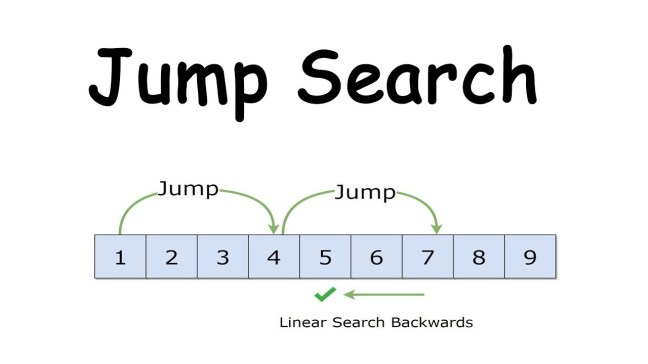
The basic idea is to check fewer elements (than linear search) by jumping ahead by fixed steps or skipping some elements in place of searching all elements.
Important points
- Works only sorted arrays.
- The optimal size of a block to be jumped is (√ n). This makes the time complexity of Jump Search O(√ n).
- The time complexity of Jump Search is between Linear Search ((O(n)) and Binary Search (O(Log n)).
- Binary Search is better than Jump Search, but Jump search has an advantage that we traverse back only once (Binary Search may require up to O(Log n) jumps, consider a situation where the element to be searched is the smallest element or smaller than the smallest). So in a system where binary search is costly, we use Jump Search.
What is the optimal block size to be skipped?
In the worst case, we have to do n/m jumps and if the last checked value
is greater than the element to be searched for, we perform m-1 comparisons more
for linear search. Therefore the total number of comparisons in the worst case
will be ((n/m) + m-1). The value of the function ((n/m) + m-1) will be minimum
when m = √n. Therefore, the best step size is m = √n.

APPROACH
For example, suppose we have an array arr[] of size n and block (to be jumped) size m. Then we search at the indexes arr[0], arr[m], arr[2m]…..arr[km] and so on. Once we find the interval (arr[km] < x < arr[(k+1)m]), we perform a linear search operation from the index km to find the element x.
Let’s consider the following array: (0, 1, 1, 2, 3, 5, 8, 13, 21, 34, 55, 89, 144, 233, 377, 610). Length of the array is 16. Jump search will find the value of 55 with the following steps assuming that the block size to be jumped is 4.
STEP 1: Jump from index 0 to index 4.
STEP 2: Jump from index 4 to index 8.
STEP 3: Jump from index 8 to index 12.
STEP 4: Since the element at index 12 is greater than 55 we will jump back
a step to come to index 8.
STEP 5: Perform linear search from index 8 to get the element 55.
CODE
import math

def jumpSearch( arr , x , n ):

    # Finding block size to be jumped
    step = math.sqrt(n)

    # Finding the block where element is
    # present (if it is present)
    prev = 0
    while arr[int(min(step, n)-1)] < x:
        prev = step
        step += math.sqrt(n)
        if prev >= n:
            return -1

    # Doing a linear search for x in
    # block beginning with prev.
    while arr[int(prev)] < x:
        prev += 1

        # If we reached next block or end
        # of array, element is not present.
        if prev == min(step, n):
            return -1

    # If element is found
    if arr[int(prev)] == x:
        return prev

    return -1

# Driver code to test function
arr = [ 0, 1, 1, 2, 3, 5, 8, 13, 21,
    34, 55, 89, 144, 233, 377, 610 ]
x = 55
n = len(arr)

# Find the index of 'x' using Jump Search
index = jumpSearch(arr, x, n)

# Print the index where 'x' is located
print("Number" , x, "is at index" ,"%.0f"%index)
Output: Number 55 is at index 10
 Python, Data structures, OOPS, Big O
One thought on “Jump Search”